Role
Design Manager
Prepared for
General circulation

Designing a protocol migration around what would hurt most

If a transfer stalled and wasn’t retried within 7 days, the funds in it were gone for good. I designed the flows and a dashboard that sorted each person’s tasks by consequence. The L1 → L2 migration completed on June 28, 2024, with no significant incidents and zero funds lost.

Client
Edge & Node, for The Graph
Year
2023–2024
Users
Subgraph developers, Indexers, Delegators, Curators

Problem

The whole protocol moved from Ethereum to Arbitrum to save on gas fees, and everyone with tokens staked in it had to move them. A transfer that stalled and wasn’t retried within 7 days meant permanent loss of funds.

What I did

I mapped every participant type against every contract and wallet variation: 9+ complete flow variants. Then I designed a dashboard that sorted each person’s tasks by what they stood to lose.

Outcome

Zero funds lost. The L1 → L2 migration completed on June 28, 2024, with no significant incidents, and all rewards moved to Arbitrum.

In plain terms

The Graph is an indexing protocol for blockchain data, and it runs on people putting up its token, GRT. In 2023 and 2024 the whole protocol moved from Ethereum to Arbitrum to save on gas fees. Everyone with GRT in it had to move their own, and each of them had something different to lose.

Who had what at stake. Indexer: stakes their own GRT. What it does: Collateral for honest data: bad answers get it slashed. What they could lose: Their stake, and the rewards it earns. Delegator: delegates GRT to an Indexer. What it does: Adds to an Indexer’s capacity, for a share of the rewards. What they could lose: Their GRT. They couldn’t move until their Indexer had. Curator: signals GRT on a subgraph. What it does: Points Indexers at subgraphs worth indexing. What they could lose: Their signal. It stopped earning when the subgraph moved. Subgraph owner: owns it, with some signal. What it does: Publishes the API apps query; signal attracts Indexers. What they could lose: The subgraph, and downtime for the apps that query it. Vesting owner: GRT locked on a schedule. What it does: Can be staked or delegated, from inside the contract. What they could lose: Their GRT, with extra steps and more ways to stall halfway. For all of them: a transfer that failed on Arbitrum and wasn’t retried within 7 days was lost for good.WhoWhat their stake doesWhat they could loseIndexerstakes their own GRTCollateral for honest data:bad answers get it slashedTheir stake, and the rewardsit earnsDelegatordelegates GRT to an IndexerAdds to an Indexer’s capacity,for a share of the rewardsTheir GRT. They couldn’t moveuntil their Indexer hadCuratorsignals GRT on a subgraphPoints Indexers at subgraphsworth indexingTheir signal. It stopped earningwhen the subgraph movedSubgraph ownerowns it, with some signalPublishes the API apps query;signal attracts IndexersThe subgraph, and downtime forthe apps that query itVesting ownerGRT locked on a scheduleCan be staked or delegated,from inside the contractTheir GRT, with extra steps andmore ways to stall halfwayFor all of them: a transfer that failed on Arbitrum and wasn’t retried within 7 days was lost for good.Who had what at stake, stacked. Indexer: stakes their own GRT. What it does: Collateral for honest data: bad answers get it slashed. What they could lose: Their stake, and the rewards it earns. Delegator: delegates GRT to an Indexer. What it does: Adds to an Indexer’s capacity, for a share of the rewards. What they could lose: Their GRT. They couldn’t move until their Indexer had. Curator: signals GRT on a subgraph. What it does: Points Indexers at subgraphs worth indexing. What they could lose: Their signal. It stopped earning when the subgraph moved. Subgraph owner: owns it, with some signal. What it does: Publishes the API apps query; signal attracts Indexers. What they could lose: The subgraph, and downtime for the apps that query it. Vesting owner: GRT locked on a schedule. What it does: Can be staked or delegated, from inside the contract. What they could lose: Their GRT, with extra steps and more ways to stall halfway. For all of them: a transfer that failed on Arbitrum and wasn’t retried within 7 days was lost for good.Indexerstakes their own GRTCollateral for honest data:bad answers get it slashedTheir stake, and the rewardsit earnsDelegatordelegates GRT to an IndexerAdds to an Indexer’s capacity,for a share of the rewardsTheir GRT. They couldn’t moveuntil their Indexer hadCuratorsignals GRT on a subgraphPoints Indexers at subgraphsworth indexingTheir signal. It stopped earningwhen the subgraph movedSubgraph ownerowns it, with some signalPublishes the API apps query;signal attracts IndexersThe subgraph, and downtime forthe apps that query itVesting ownerGRT locked on a scheduleCan be staked or delegated,from inside the contractTheir GRT, with extra steps andmore ways to stall halfwayFor all of them: a transfer that failedon Arbitrum and wasn’t retried within7 days was lost for good.
Fig. 1Who had GRT in the protocol, what it did there, and what each could lose if their move went badly (heavy outline). Drawn in 2026 from The Graph’s documentation. One person or company could be more than one of these.Drawing: James
Glossary 5 terms
L1 and L2
Layer 1 is the base blockchain, here Ethereum. Layer 2 is a network built on top of it with lower fees.
Arbitrum
The Layer 2 network The Graph moved to.
GRT
The Graph’s token, used for staking and to pay for queries.
Gas
The fee a blockchain charges to process a transaction.
Vesting contract
A smart contract that releases tokens to someone over time. Tokens held this way needed extra steps to move.
The migration

L1 → L2: moving the protocol from Ethereum to Arbitrum

Nobody wanted to migrate. My job was to make a painful process smooth enough that people finished it, and to make sure nobody lost funds because they got confused or dropped off halfway.

Decision 1

Sort each person’s tasks by what would hurt most if ignored

A migration could stall halfway, so separate flows weren’t enough.
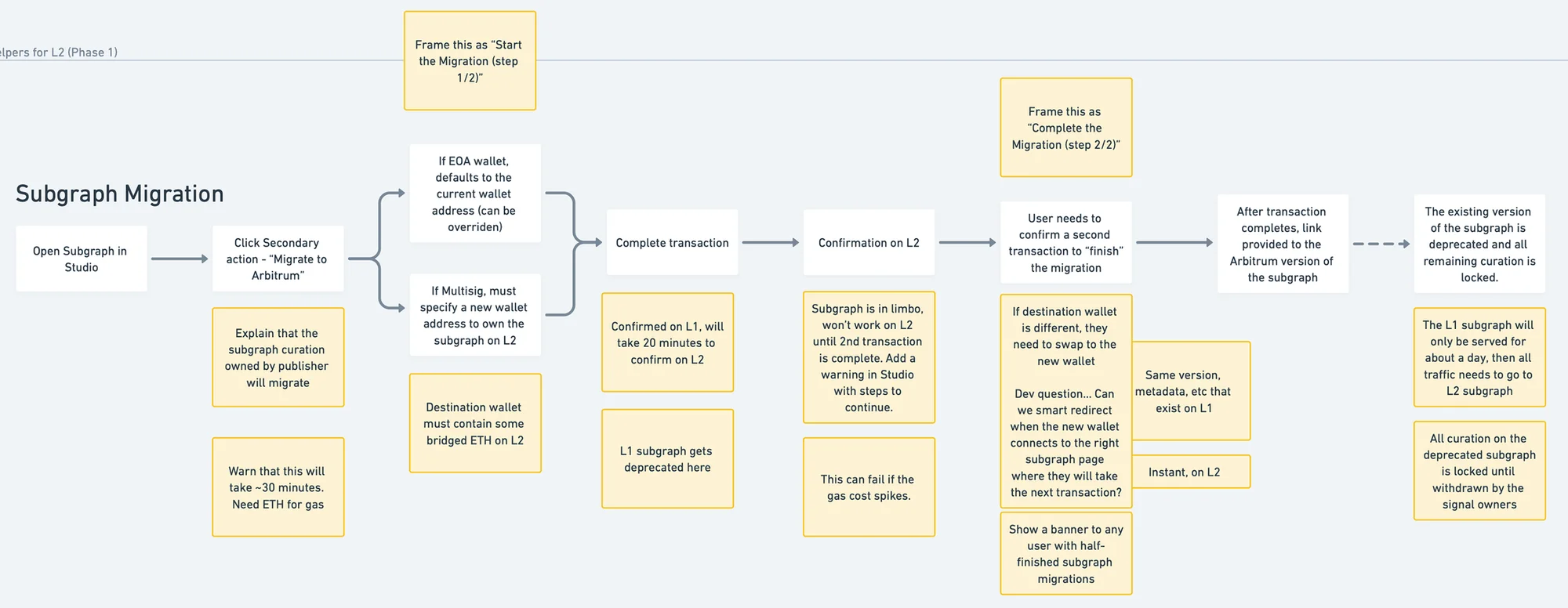
Fig. 2The subgraph flow, from my original file. After the first transaction a subgraph sat “in limbo” until a second one finished it, so my notes ask for a warning with the steps to continue and a banner for anyone who stopped halfway. Cropped; select to open full size.Flow: JamesOpen full size

I designed a dashboard that detected where each person stood and showed their next action, ordered by what they stood to lose. 1 Urgent action needed: an incomplete transfer near a deadline where funds would be lost, with the deadline and the consequence stated plainly. 2 Incomplete transfers: started, but waiting on a second transaction, with the next step spelled out. 3 Ready to transfer: everything still to move, grouped by type. Someone with a vesting contract, three subgraphs, delegation on two Indexers and curation signal could see every task in one place.
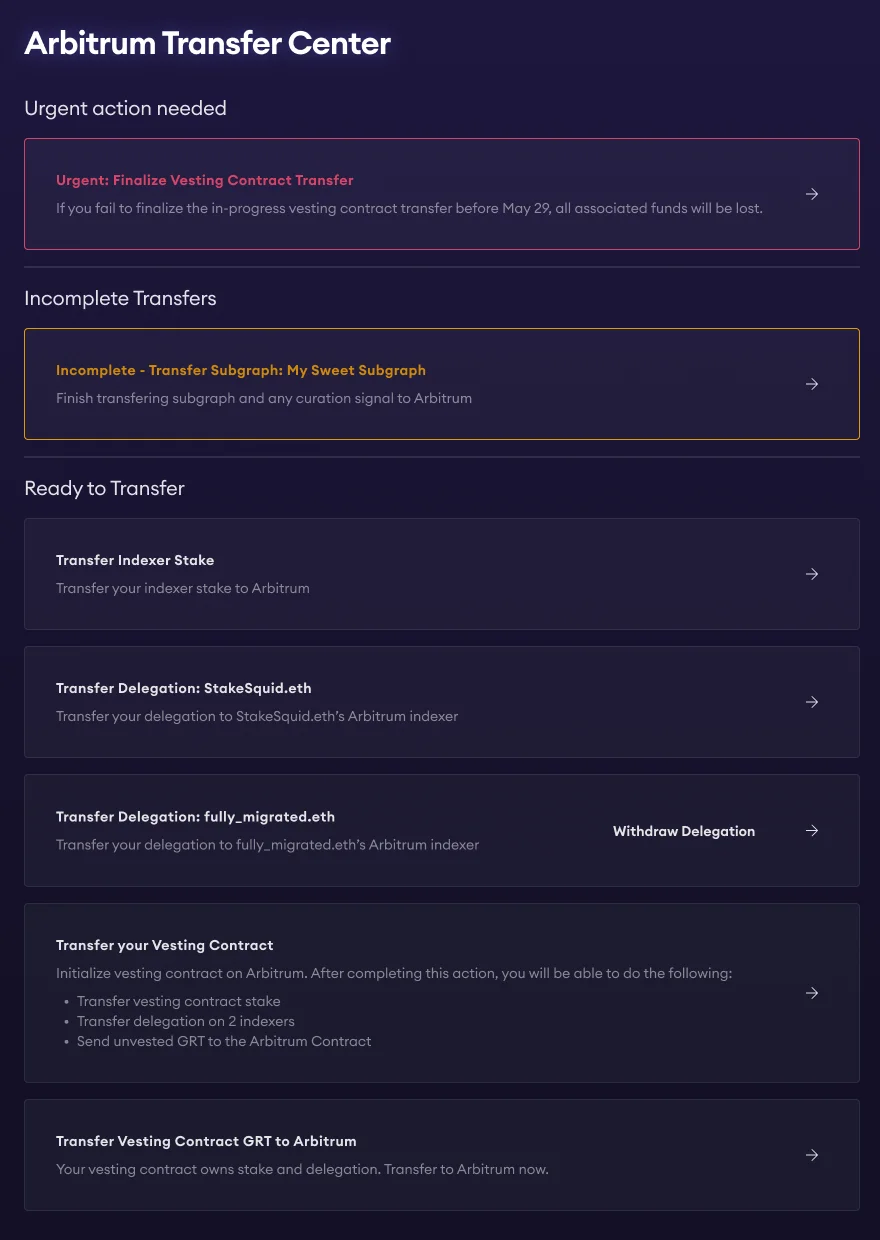
Fig. 3Arbitrum Transfer Center in Graph Explorer, the shipped screen, shown with sample data. Pins 1 to 3 mark the three groups, ordered by what each person stood to lose; urgency is set in red and yellow. Cropped; select to open full size.Flows and states: James · Visual UI: Edgar PridayOpen full size
Decision 2

Design a flow for every participant type, not one wizard for the “average” one

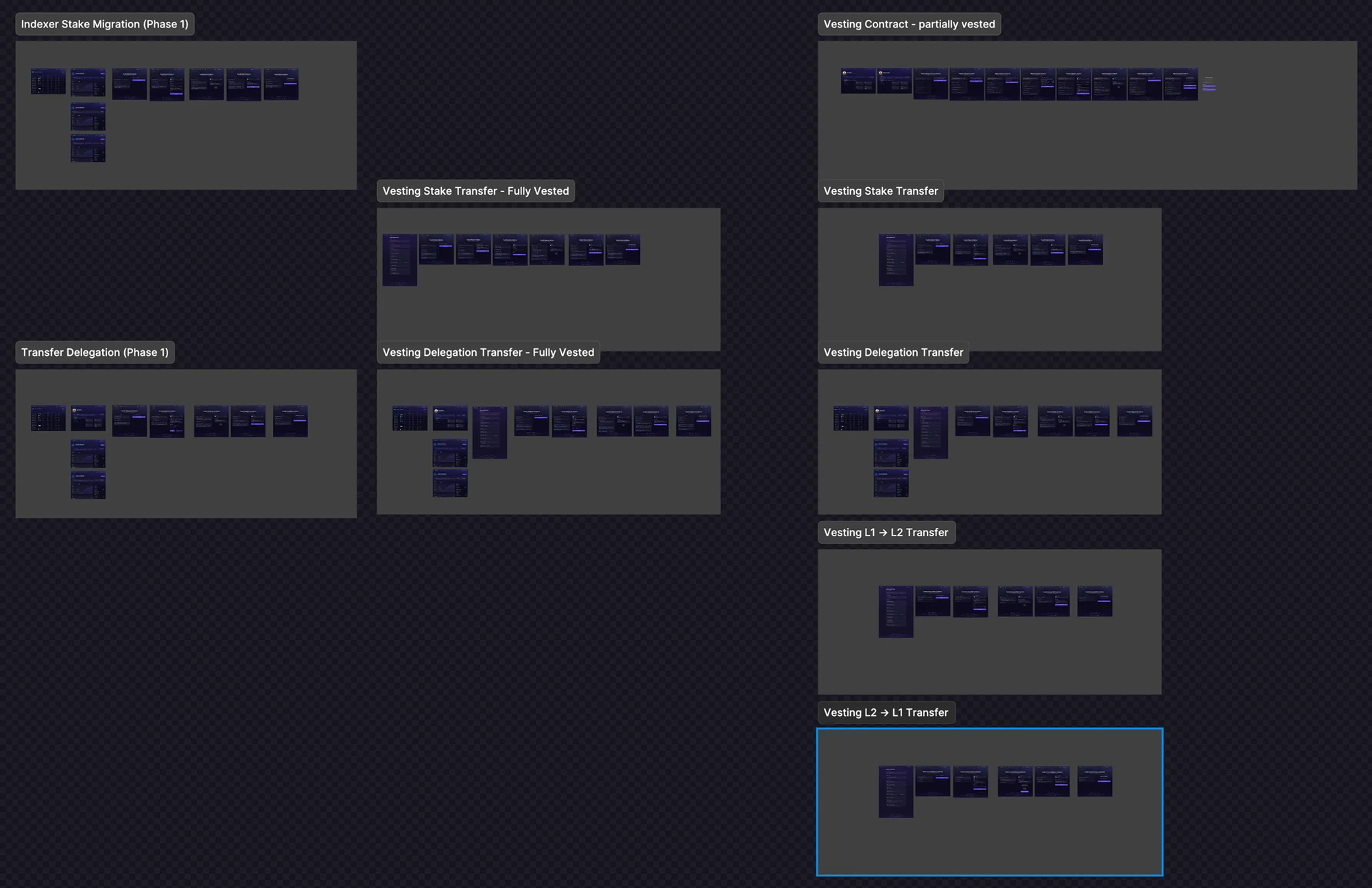
The network’s participants weren’t simple, so a simple migration tool wasn’t going to work. Some Indexers held tokens through vesting contracts, and each vesting status meant different smart-contract steps. I mapped every participant type against every contract and wallet variation, and the final Figma file had 9+ complete flow variants. Each covered its own transaction sequence, confirmation states and errors, plus what happens if someone closes the browser between steps.
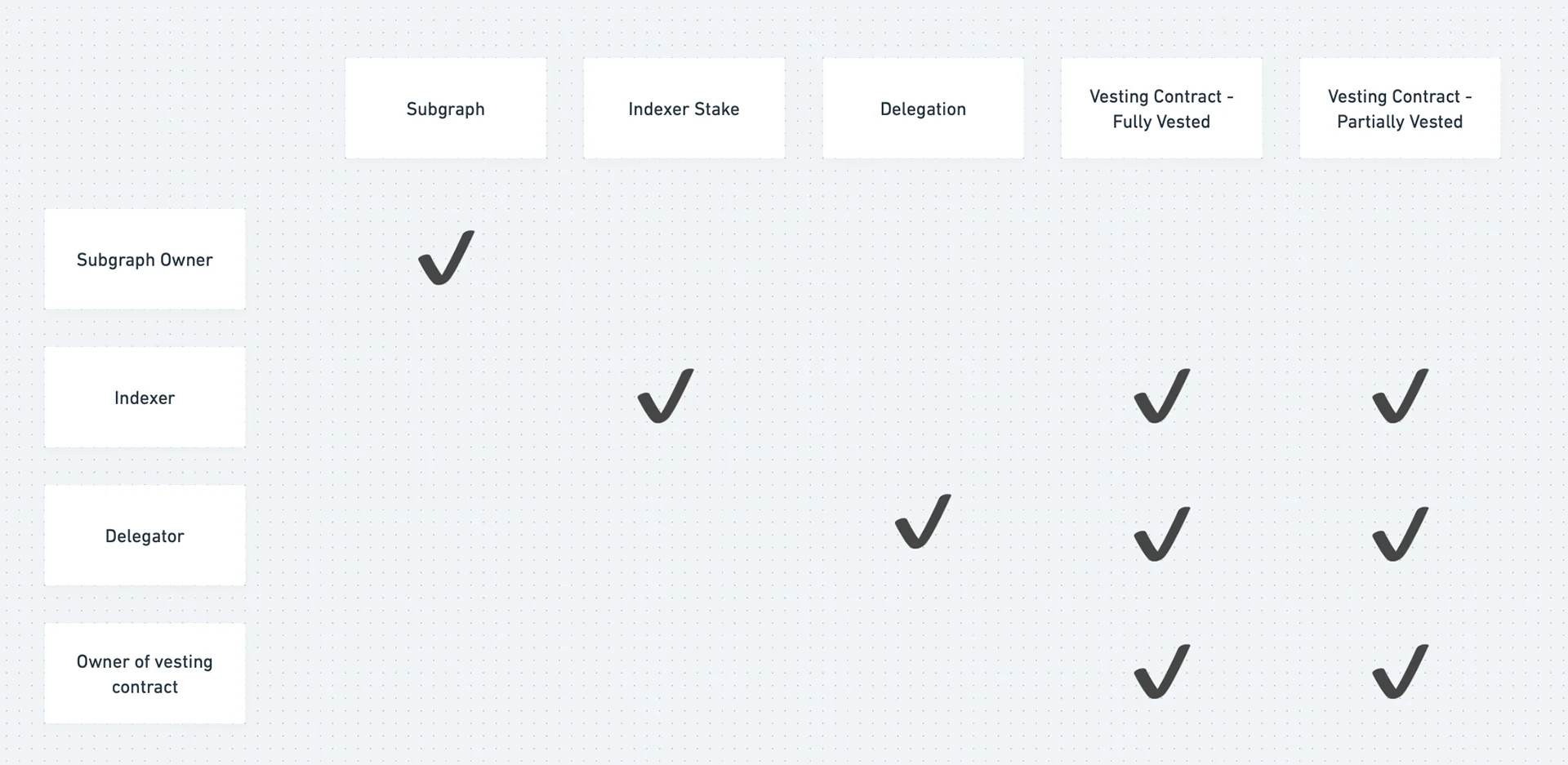
Grid of participant types against what each could hold. Subgraph owner: a subgraph. Indexer: Indexer stake, and vesting contracts fully or partly vested. Delegator: delegation, and vesting contracts fully or partly vested. Vesting contract owner: vesting contracts fully or partly vested. Nine dots in all, bracketed: each is at least one complete flow, nine or more flow variants.SubgraphIndexer stakeDelegationVestingVestingfully vestedpartly vestedSubgraph ownerIndexerDelegatorVesting contract owner9+ complete flow variants, one or more for each dotThe same grid, by participant: subgraph owner holds a subgraph; Indexer holds stake and vesting contracts, fully or partly vested; Delegator holds delegation and both vesting states; a vesting contract owner holds both vesting states. Nine in all, nine or more flow variants.Subgraph ownerSubgraphIndexerIndexer stakeVesting, fully vestedVesting, partly vestedDelegatorDelegationVesting, fully vestedVesting, partly vestedVesting contract ownerVesting, fully vestedVesting, partly vested9+ complete flow variants,one for each dot or more
Fig. 4Who could hold what, schematic. Redrawn in 2026 from the participant matrix in the original Figma file. Each dot needed at least one complete flow of its own. Open the original matrixMapping: James
Fig. 5Part of the final Figma file, from a distance: the stake, delegation and vesting flows. Each group is one flow, drawn screen by screen.Flows and states: James · Visual UI: Edgar PridayOpen full size

A beautiful migration wizard that breaks for people with vesting contracts isn’t a good migration wizard. It’s a support ticket generator.

Outcome

A mandatory migration, finished with no significant incidents

Zero

funds lost in the migrationHundreds of subgraphs and Indexers and thousands of Delegators moved to Arbitrum. It completed on June 28, 2024.

All rewards moved to Arbitrum too. For a mandatory migration involving real staked assets, “easy” is the highest compliment. In September 2023, while the transfer tools were live, the community account GRTiQ asked on X who had used them:
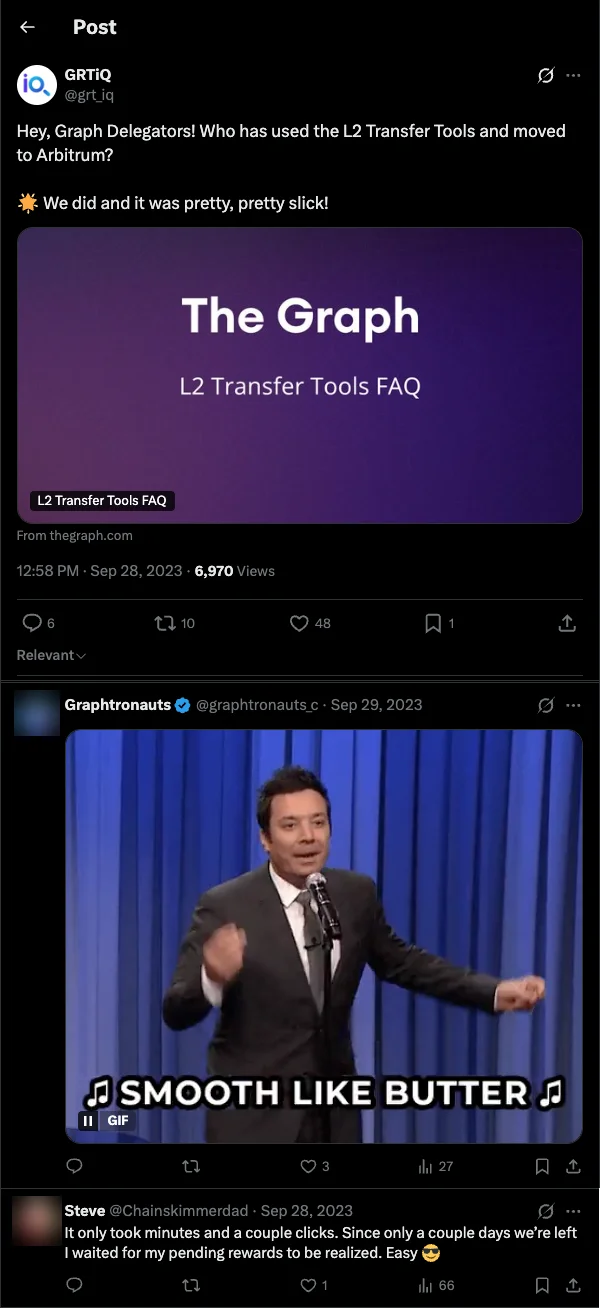
GRTiQ @grt_iq · Sep 28, 2023

“Hey, Graph Delegators! Who has used the L2 Transfer Tools and moved to Arbitrum?”

“We did and it was pretty, pretty slick!”

  1. Steve @Chainskimmerdad · Sep 28, 2023

    “It only took minutes and a couple clicks. … Easy”

  2. Graphtronauts @graphtronauts_c · Sep 29, 2023

    Replied with a “Smooth like butter” GIF.

(open the screenshot of the thread)
From a public X thread, Sep 28–29, 2023. Select the thread to see the screenshot.
Open original ↗